

1 min readOwn Your Mistakes
by Guy Gage | July 28, 2019 | Business, Leadership, Personal Management
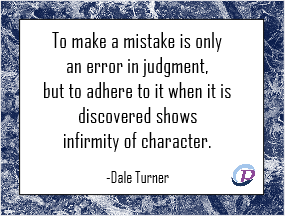
It’s Natural to Avoid
It’s natural to want to avoid accepting responsibility for errors. You don’t want to show yourself inadequate or insufficient and you certainly want to avoid consequences. And even if no one else says anything, your internal self-talk can be merciless to you.
So you say, “Not my fault. I didn’t do anything wrong. I followed through. I did what I was supposed to do.” If you catch yourself saying these things, you are subconsciously protecting yourself. It prevents you from thinking more thoroughly. So, rather than ask, “Did I have a part in this mistake?” you declare with certainty that you did not. Hmm. Thou protesteth too much?
Earn Confidence 3 Ways
But when you assume responsibility for your mistakes, you actually earn the confidence of others in three ways. First, it shows you know that a mistake was made. Everyone makes mistakes. The important thing is that you know enough to be aware of it and accept it. You are competent enough to know.
Second, you earn confidence when you accept responsibility and don’t blame, excuse or justify. There’s something appealing to others when you step up and own it, especially when there is risk involved.
Third, it demonstrates that you are open to learning. You accept counsel and take feedback as a learning experience, not personally. You are open to new ideas, approaches, and learning. And you avoid being labeled as uncoachable or always having to be right. Instead, you demonstrate professionalism and high competence-potential.
What About You?
When’s the last time you took ownership for a mistake? Admitted your failing? Assumed responsibility?
What did you have to overcome to do so? Pride? Fear of feeling stupid or showing inadequacy?
Finally, what propelled you to go against your self-protective tendencies?
When you have the courage to own your mistake, you earn the confidence of others.
Read Related Blogs:
Empowering Your CPA Team: Ditch the Whip for True Ownership
Picture this: It's tax season crunch time. Your senior associate, Sarah, spots a subtle mismatch in a client's depreciation schedule that could trigger an audit flag. In the old days, she'd flag it for review and wait for your sign-off - classic accountability mode,...
It’s Not Fragility. It’s a Skills Gap – And You Can Fix It
Young professionals are entering firms in a markedly different mental and emotional state than previous generations. They’ve grown up amid economic instability, political and social division, and ongoing global conflict. At the same time, many were raised by highly...
Scale Your Expectations to Match the Season, Not the Ideal
Every season is unique and asks something different of you. Some chapters feel spacious and steady; others tighten the margins and demand more time, focus, or energy bandwidth than you’d prefer. When life intensifies, the instinct is often to cling to your ideal...

